
Electricity can cut the cost of each mile. Autonomy can change how many miles a truck earns money.
By Amine • September 25, 2026
I’m bullish on the Tesla Semi because trucking is a business where small savings per mile become big money over time. Give a fleet a meaningful operating-cost advantage, and it has a reason to redesign routes, charging schedules and trailer handoffs around it.
But the competitive picture is changing. Tesla has to compete with trucks that burn diesel and trucks that can move freight without a human driver.
That second challenge deserves more attention.
Start with the energy bill
There is real customer evidence behind the Semi’s efficiency. During a two-week trial, DHL ran a Tesla Semi for about 3,000 miles and reported average consumption of 1.72 kWh per mile. The trial included a 390-mile trip at 75,000 pounds gross combined weight—the truck, trailer and cargo together. [1]
Here is a simple illustration, using assumptions rather than claiming these are today’s national fuel prices:
| Input | Diesel truck | Tesla Semi example |
| Energy price assumed | $4.00/gallon | $0.15/kWh |
| Energy use | 6.5 miles/gallon, assumed | 1.72 kWh/mile, DHL trial |
| Charging allowance | — | 90% efficiency, assumed |
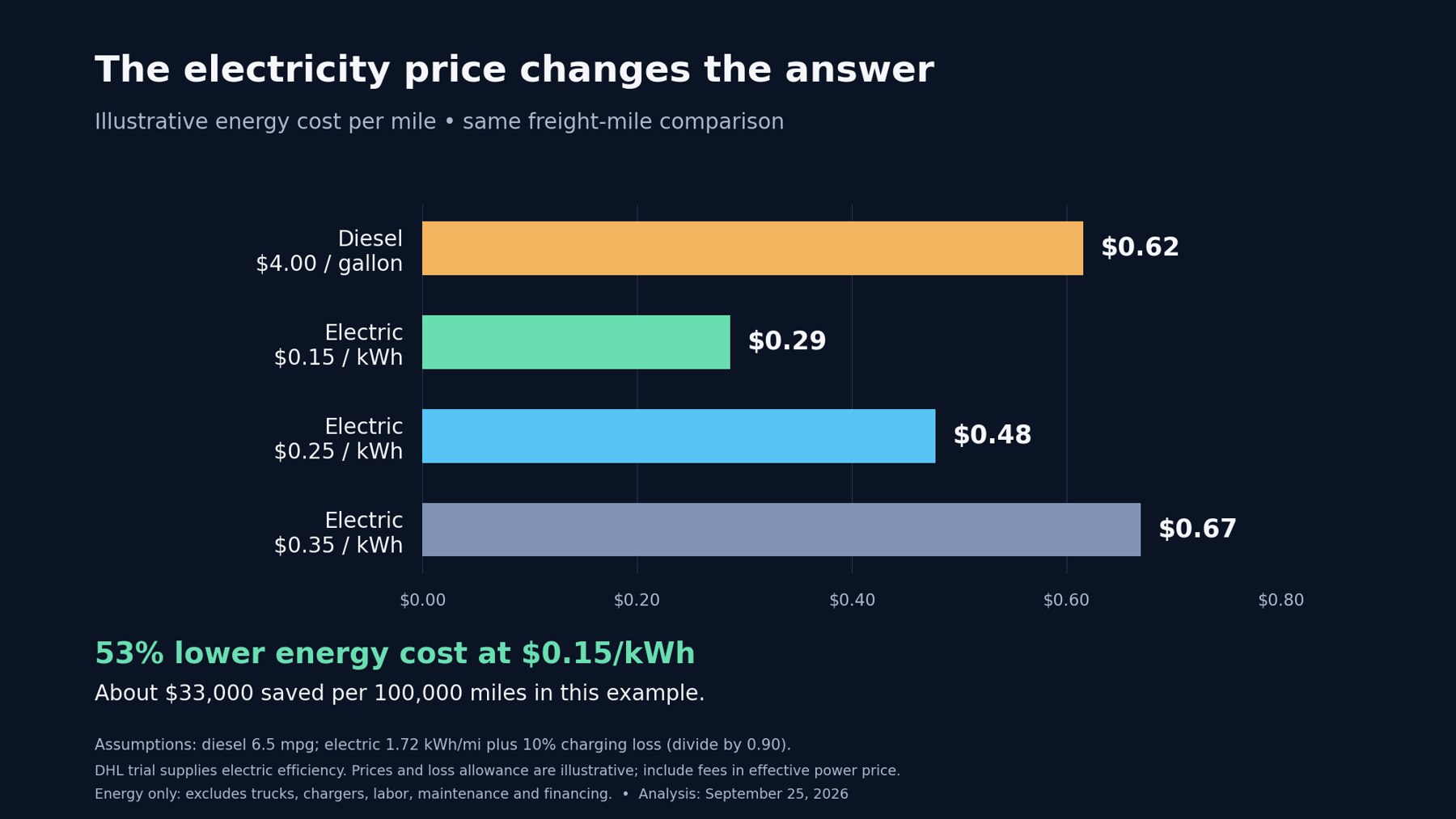
| Energy cost per mile | $0.62 | $0.29 |
| Energy cost over 100,000 miles | $61,538 | $28,667 |
That is approximately $33,000 in annual energy savings, or 53%, at 100,000 miles.
The math is straightforward: $4 ÷ 6.5 for diesel, and 1.72 ÷ 0.90 × $0.15 for electricity. The charging allowance treats DHL’s reported consumption as vehicle-side energy use for this example; it is not a measured loss from DHL’s trial.
Electricity pricing matters. At $0.25/kWh, the electric example rises to about 48¢ per mile. At $0.35/kWh, it reaches 67¢, exceeding this diesel example. Charging fees and utility demand charges must be reflected in the fleet’s effective electricity price. Buying trucks and installing chargers are additional costs.
Maintenance strengthens the case—but needs honest accounting
An electric truck eliminates engine-oil changes and diesel exhaust-treatment equipment. Regenerative braking can also reduce brake wear. The U.S. Department of Energy explains that battery-electric vehicles generally need less maintenance because they have fewer moving parts and fewer fluids to replace. [2]
That supports the direction of the argument. It does not establish a universal percentage saving for Tesla Semi fleets. Tires, suspension, cooling systems, repairs and battery durability still matter.
The question for a fleet is the total cost of delivering the same freight, including purchase price, financing, payload, labor, infrastructure and downtime.
Could two electric trucks replace one diesel?
On some routes, a fleet might rotate tractors: one charges while another takes the trailer. Trailer handoffs and relay operations could help make electric trucking work where a simple one-for-one replacement is awkward.
But two trucks do not automatically beat one economically.
Suppose two electric tractors split the same 100,000 combined annual miles that one diesel tractor previously covered. In the example above, their combined energy saving is still about $33,000. It does not double because there are two trucks.
That saving must help cover the extra tractor’s annual ownership costs, charging infrastructure and any additional operating expense. Extra repositioning miles would reduce it further.
My argument is that fleets have an incentive to redesign operations when the savings justify it. Whether a 2:1 arrangement works has to be demonstrated route by route.
Drivers’ breaks create a charging opportunity
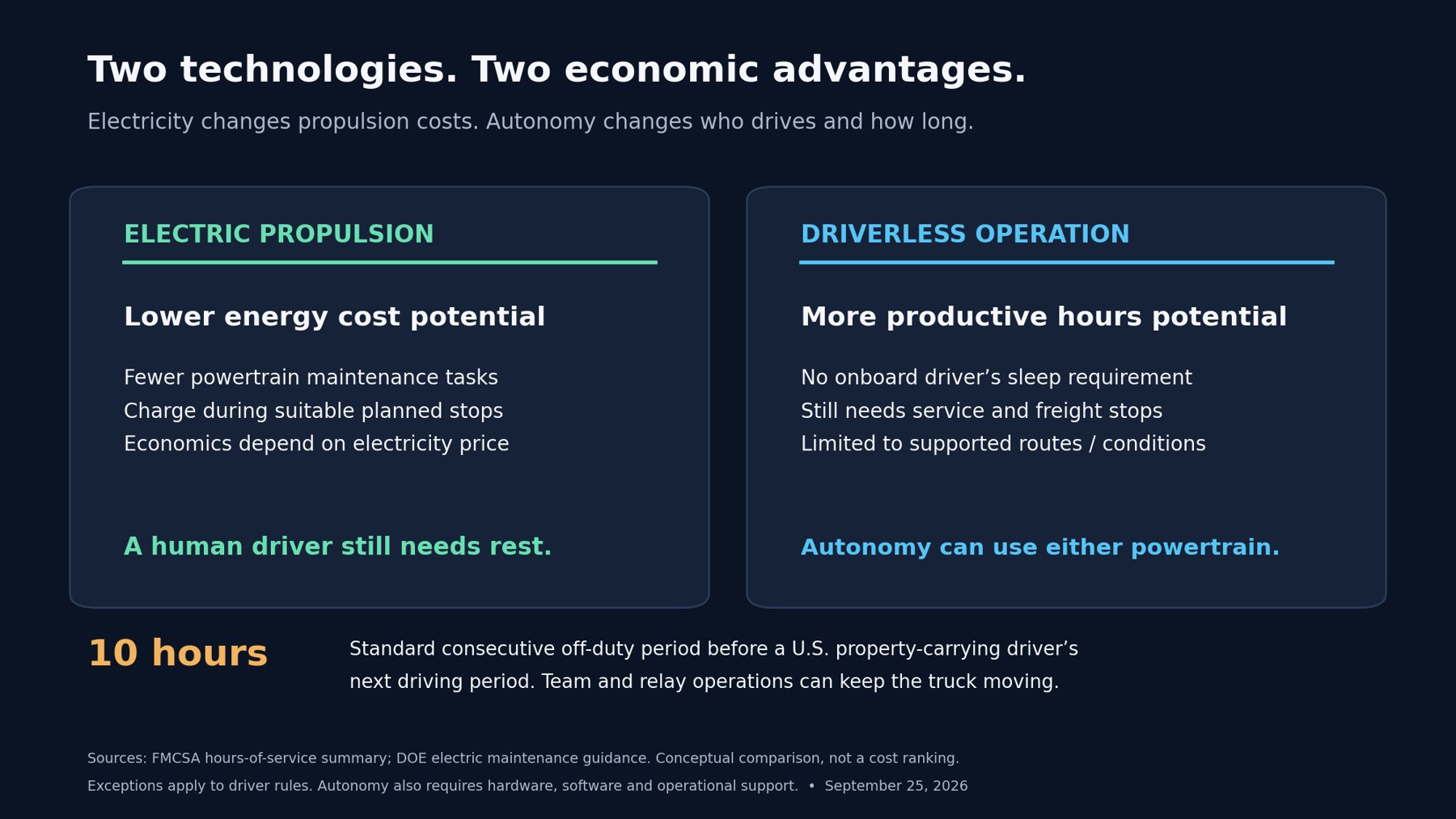
For U.S. property-carrying drivers, the standard federal rules generally allow up to 11 hours of driving after 10 consecutive hours off duty, within a 14-hour duty window. A 30-minute break is generally required after eight cumulative hours of driving without a qualifying interruption. Exceptions and sleeper-berth provisions apply. [3]
Those planned stops can provide charging opportunities when the charger, route and schedule line up. Tesla advertises recovery of up to 60% of range in about 30 minutes using a Megacharger; actual results depend on charging conditions. [4]
Charging during a stop the operation already needs can reduce the additional time cost of going electric. However, driver rest does not always mean truck rest: teams and relay drivers can keep a conventional truck moving.
Autonomy changes the utilization equation
Aurora already operates commercial driverless freight services. On September 23, it reported more than 500,000 driverless miles since commercial launch. It also said trucks serving McLane, Werner and other customers were averaging an annualized pace above 225,000 miles. That is a company-reported operating rate, not a claim that every truck had already completed a full year at that mileage. [5]
Kodiak AI is also doing paid driverless work. It reported 35 customer-owned driverless trucks and more than 40,000 cumulative paid driverless operating hours through the second quarter of 2026. [6]
The distinction matters: Kodiak’s live driverless deployment is industrial hauling in the Permian Basin. Its September 8 update still targeted driverless long-haul commercial service by the end of 2026. The two companies are at different stages in highway deployment. [7]
A driverless truck does not need a human sleep break. It still stops for fuel or charging, inspections, maintenance and freight handling, and it must stay within the routes and conditions its system can handle. Autonomy also carries hardware, software and support costs.
Even with those limits, removing the onboard driver’s rest requirement can make a truck more productive. A higher energy bill per mile may be offset by lower onboard driving-labor requirements and more productive use of the vehicle. That is an economic possibility to evaluate, not proof that every autonomous diesel is cheaper than every electric truck.
Tesla has an opportunity—and a gap to close
I expect Tesla to pursue autonomy for the Semi. But an expectation about future software should not be counted as a driverless freight capability already available to a customer.
Until Tesla demonstrates and deploys that capability, the Semi competes as a highly efficient electric truck whose human driver still has working-hour limits.
My thesis is that Tesla can make a compelling case against conventional diesel on suitable routes. Its tougher strategic challenge will be autonomous trucks that can keep earning through hours when a solo driver needs to rest.
The strongest long-term combination could be electric propulsion plus autonomy. These technologies can work together, and that opportunity is open to more than one company.
For fleet owners, the deciding number will be the cost of moving a load reliably and on time. Tesla’s energy advantage gets it into that conversation. Autonomy could decide how much of the business it wins.
Sources
Company operating figures are attributed to the companies reporting them. Cost comparisons are illustrative calculations, not a fleet quote or measured total-cost study. Information checked September 25, 2026.
1. DHL: Tesla Semi trial and first delivery
2. U.S. Department of Energy: Electric vehicle maintenance
3. FMCSA: Summary of hours-of-service regulations
4. Tesla: Semi charging specifications
5. Aurora: September 23, 2026 operating update